
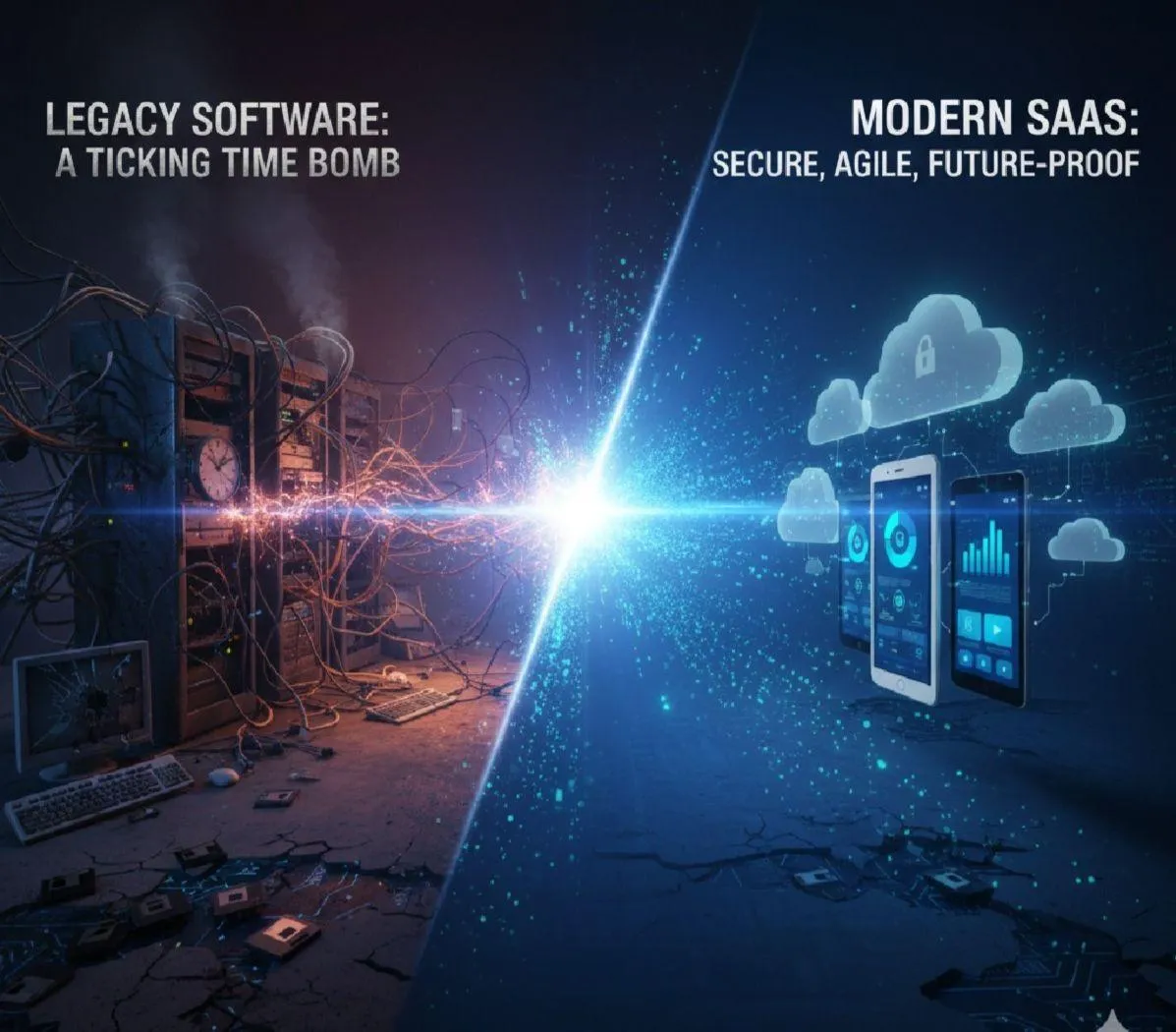
Is Your Legacy Creating Future Risk
Is Your "Heritage Software" Now a Ticking Time Bomb? The Hidden Cost of Clinging to Legacy IT
As an industry leader who has guided global enterprises through major digital transformations, I can tell you a universal truth: the cost of custom development pales in comparison to the hidden, annual cost of keeping obsolete software alive.
We often hear CIOs express fear about the expense and disruption of rebuilding core systems. But that fear distracts from the very real and accelerating dangers posed by so-called "heritage software." This is not just old software; it is archaic, inflexible, and, increasingly, a massive liability.
The Ticking Clock: Three Hidden Costs of Legacy IT
Clinging to legacy IT systems creates a cascading effect of financial risk and operational drag. Calculating the true operational cost of non-upgradable software might just be the most important financial exercise your CFO undertakes this quarter.
1. Security and Compliance Vulnerability
Archaic systems are notoriously difficult to patch and update, leaving critical data exposed. In a data-driven economy where safeguarding privacy and security is a top priority , a vulnerability in an old, in-house solution can lead to crippling fines, regulatory breaches (like failing to maintain GDPR Compliant status ), and massive reputational damage.
2. Inflexibility and Stagnation
Modern business demands agility—the ability to launch a new product, adapt to a market shift, or integrate with a new partner ecosystem quickly. Legacy systems are fundamentally incapable of this. They often exist in silos, making it impossible to concentrate multiple data sources or achieve the rapid business agility needed to compete. If your software is not built to evolve, your business can't either.
3. Maintenance Tax and Talent Drain
Keeping heritage software running requires increasingly specialized and expensive knowledge. As the engineers who built these systems retire, maintaining them becomes a constant firefighting exercise—the "maintenance tax." This drains IT budgets and diverts talented developers away from innovation and toward simple life support.
The Low-Code Solution: A Fast, Secure, and Cost-Effective Transition
The good news is that the solution is no longer a multi-year, multi-million-dollar waterfall project. The advent of modern, low-code development platforms has fundamentally changed the economics and timeline of digital transformation.
Lodeware specializes in rapidly migrating and rebuilding legacy applications onto cutting-edge SaaS multi-platform accessible software. Our process is built on speed, flexibility, and compliance:
No-Code Application Development and Tailoring: We easily create and modify applications in accordance with your exact business needs. This enables a fast transition that minimizes disruption and accelerates your time-to-value.
Consolidation and Compliance: We replace disparate, costly legacy apps with a cloud-based, flexible, and powerful multi-platform compatible SaaS solution. This ensures that old data is securely migrated and that your new systems meet modern security standards, backed by a standardized security framework.
Digital-First Experience: Our solutions are designed to support transformation through actionable insights and data-driven solutions, capturing and correlating enterprise-wide data to yield high-value business cases.
The Mandate for Change
The time to calculate the true cost of legacy risk is now. Does your current IT budget reflect the cost of potential audit failure, security breaches, and lost opportunities due to system inflexibility?
Moving from an archaic, in-house solution to a modern, low-code platform is the key to longevity in a continually changing technological landscape. It’s about more than just reducing a line item—it’s about safeguarding your company's future and restoring operational agility.
What is the single biggest barrier—fear, budget, or knowledge—to modernizing IT in your organization? Share your thoughts and join the conversation.
#LegacyIT #LowCode #DigitalTransformation #ITModernization #SaaS